
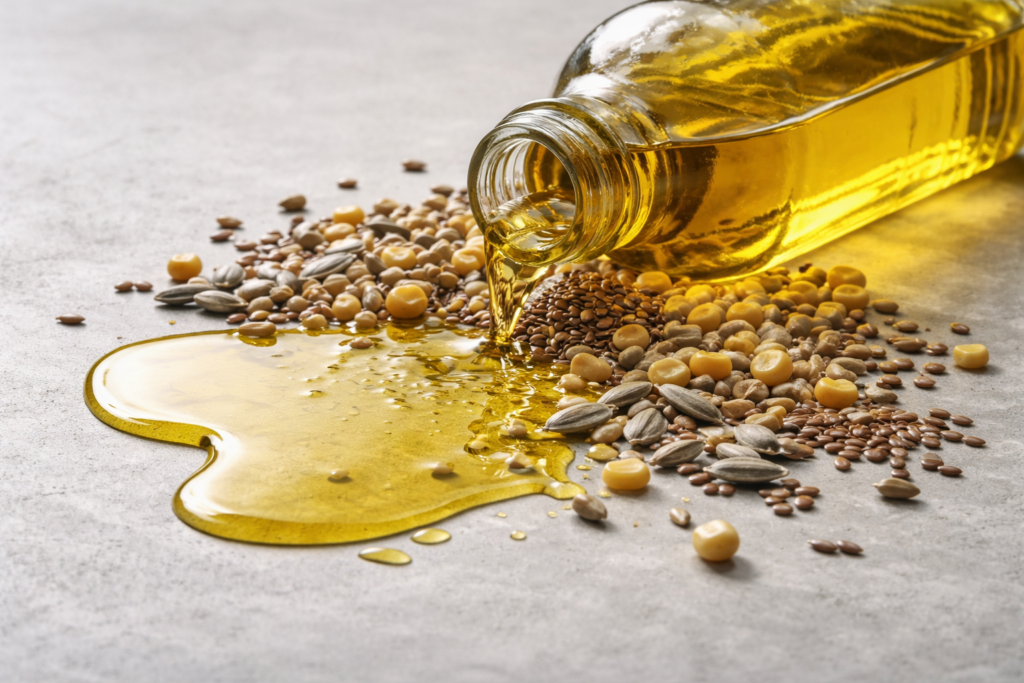
Short verdict: Seed oils are not toxic, uniquely damaging, or quietly driving chronic disease. When examined in human research—not charts, theories, or isolated lab experiments—diets that include seed oils in place of saturated fats consistently align with better cardiovascular markers and, in many cases, lower disease risk. The strongest claims against them lean on speculation rather than real-world outcomes. For most diets, seed oils are a supporting detail, not the central issue.
How seed oils became a lightning rod in health debates
Seed oils didn’t rise to controversy because of a new wave of human data showing harm. They became controversial because they’re convenient to blame.
They’re widely used in packaged foods and restaurant meals. They’re industrially produced. And their consumption increased during the same decades that obesity, diabetes, and heart disease became major public health concerns. That timing alone was enough to make them suspicious.
From there, the narrative filled itself in. Parallel trend charts were treated as proof. Biochemical pathways were simplified into headlines. Words like “industrial” and “toxic” did a lot of work without much support behind them. Once the idea took hold that seed oils were a modern mistake, it spread quickly—especially in spaces that reward clear villains and simple explanations.
What tends to get lost is the part that actually matters: what happens to people who consume these oils over time.
What people are really talking about when they say “seed oils”
Seed oils are fats extracted from plant seeds such as soybean, sunflower, corn, safflower, and canola (rapeseed). Nutritionally, they’re primarily sources of unsaturated fats, especially polyunsaturated fatty acids.
One of these fats—linoleic acid—belongs to the omega-6 family. Omega-6 fats are essential, meaning the body can’t produce them on its own. They play roles in cell membranes, signaling molecules, and normal immune function.
The confusion begins with a technically true statement that often gets overstretched: omega-6 fats can participate in inflammatory pathways. That’s accurate at a biochemical level. What’s missing is the follow-up question—whether consuming omega-6 fats in normal diets actually increases inflammation or disease risk in people.
Human biology includes many pathways that can be involved in inflammation without creating chronic inflammatory states. That distinction is central to this discussion.
What long-term human research actually finds
When researchers look at seed oils using methods that track health outcomes over time—randomized dietary trials, large cohort studies, and objective biomarkers—the results are consistent and unremarkable in the best sense of the word.
Cardiovascular outcomes generally improve
Replacing saturated fats such as butter or lard with unsaturated fats from seed oils reliably lowers LDL cholesterol. This finding has been reproduced across decades of controlled trials.
Lower LDL is not just a laboratory detail. It tracks closely with reduced risk of heart attacks and other cardiovascular events. Populations that consume more polyunsaturated fats in place of saturated fats tend to experience fewer heart-related outcomes over time.
This pattern appears again and again across different study designs. If seed oils were inherently harmful, it would be difficult to reconcile these results.
Higher omega-6 intake does not raise inflammation in humans
Despite frequent claims to the contrary, controlled human feeding studies do not show that higher linoleic acid intake increases markers of chronic inflammation. Reviews examining indicators such as C-reactive protein and inflammatory cytokines consistently find no meaningful rise with higher omega-6 consumption.
Some analyses even report neutral or slightly lower inflammatory markers among people with higher omega-6 levels. That doesn’t place omega-6 fats in the same category as omega-3s, which have clearer anti-inflammatory effects, but it does undermine the idea that omega-6 fats drive inflammatory disease.
Metabolic health signals are neutral to favorable
Studies that assess fatty acids directly in the blood—a more reliable approach than dietary recall—show that higher linoleic acid levels are associated with lower risk of type 2 diabetes and healthier metabolic profiles.
There is no consistent evidence that seed oils uniquely promote weight gain or insulin resistance when calorie intake and overall diet quality are taken into account.
Cancer and overall mortality show no signal of harm
Long-term cohort data do not link seed oil consumption to higher cancer risk. Some studies report lower overall mortality among people who consume more plant-based oils compared to those who consume more animal fats.
If seed oils were broadly damaging, signs would be expected to emerge in these large datasets. They do not.
Where popular arguments go beyond the data
Many of the strongest claims against seed oils rely on interpretations that extend well past what the data support.
“Omega-6 fats are inflammatory.”
Omega-6 fats can be involved in inflammatory pathways, but involvement is not the same as causation. Human trials consistently fail to show higher inflammation with higher intake.
“The omega-6 to omega-3 ratio is dangerous.”
The ratio sounds intuitive, but outcomes improve when omega-3 intake increases—not when omega-6 intake is aggressively reduced. Most diets fall short on omega-3s rather than overshooting omega-6s.
“Heating seed oils makes them toxic.”
All fats degrade to some degree when heated. Under typical home cooking conditions, this degradation has not been linked to meaningful health risk. The concern applies primarily to oils repeatedly reheated in commercial deep fryers.
“Industrial processing makes seed oils unsafe.”
Many seed oils are refined using solvents that are later removed. Residual amounts are tightly regulated and far below levels known to cause harm. This process has been examined extensively.
“Seed oils caused modern chronic disease.”
Parallel trends do not establish causation. Over the same period, calorie intake, sugar consumption, physical inactivity, and food processing all increased. Singling out one ingredient oversimplifies a much broader shift in how people eat and live.
What this debate is often actually about
Much of the anxiety around seed oils is really anxiety about ultra-processed foods.
Seed oils are common in packaged snacks, fast food, and refined convenience products. When people cut out seed oils, they often cut out those foods altogether. Health markers improve—not because the oil itself was harmful, but because the overall pattern of eating changed.
Another point of confusion is the tendency to treat theoretical mechanisms as if they guarantee real-world outcomes. Not every biological possibility translates into disease over decades of consumption. Nutrition science relies on patterns observed in people, not isolated reactions.
Seed oils often end up carrying the blame for problems driven by excess calories, low fiber intake, and heavily processed food environments.
Situations where closer attention may be reasonable
There are contexts where nuance matters.
People with established cardiovascular disease may benefit from prioritizing unsaturated fats over saturated ones, which often includes seed oils.
Those who rely heavily on fried fast food may want to scale back—not because seed oils are uniquely harmful, but because repeatedly heated oils and ultra-processed foods come with broader concerns.
Individuals with very low omega-3 intake may focus on improving that balance rather than eliminating omega-6 fats entirely.
These are situational considerations, not general warnings.
Who likely does not need to worry?
Most people.
If you cook at home, eat a mixed diet, and use seed oils in ordinary amounts, there’s no indication you’re harming your health. Children, pregnant adults, and older adults do not need to avoid them. Healthy individuals do not gain protection by cutting them out altogether.
There is no professional consensus recommending widespread avoidance.
The practical takeaway
Seed oils are not the dietary threat they’re often made out to be.
When evaluated through long-term human outcomes, they appear neutral to beneficial—particularly when they replace saturated fats. The anxiety surrounding them stems from simplified biology, selective interpretation, and confusion about what actually drives poor health.
What matters far more than whether an oil comes from a seed is the overall pattern of eating: calorie balance, fiber intake, protein adequacy, and consistency over time.
Seed oils didn’t break modern health. And avoiding them, by itself, won’t fix it.
A research overview from Harvard T.H. Chan School of Public Health explaining how different dietary fats affect cardiovascular health.
https://www.hsph.harvard.edu/nutritionsource/what-should-you-eat/fats-and-cholesterol/
A large pooled analysis published in Circulation examining blood levels of omega-6 fatty acids and cardiovascular risk.
https://www.ahajournals.org/doi/10.1161/CIRCULATIONAHA.118.038908
A systematic review in the Journal of the Academy of Nutrition and Dietetics evaluating whether linoleic acid intake increases inflammation in humans.
https://pubmed.ncbi.nlm.nih.gov/22889633/
A scientific advisory from the American Heart Association on omega-6 fats and heart disease risk.
https://www.ahajournals.org/doi/10.1161/CIRCULATIONAHA.108.191627
A long-term mortality analysis published in JAMA Internal Medicine comparing butter consumption with plant-based oils.
https://jamanetwork.com/journals/jamainternalmedicine/fullarticle/2812392